Don’t master AI. Be a Master of Your Business Process!

Seeing through the AI razzle dazzle Everything seems to be AI these days, which can become overwhelming when you have to think about how it can be used in your industry or business process. All whilst the market is screaming from all directions with their AI message. The AI razzle dazzle will continue. It will probably accelerate. Expect a ChatGPT every one or two years. … Continue reading Don’t master AI. Be a Master of Your Business Process!

Intelligent IBP: A Need for Decision Centricity

At the core, the IBP process must facilitate executive decision making.

However, it lacks focus on using best practice decisions models to facilitate #decisionquality and #decisionlearning.

We can solve these traditional IBP decision gaps, enable a reduction in decision time and analytics waste, whilst increasing employee engagement with the decision process.

#Decisionintelligence technology can digitize decisions and decision context, create a system of records for decisions and develop a decision memory that helps continuously improve #decisionquality.

This is the fifth in a series of blogs, where I describe how #intelligentautomation and #decisionintelligence can help create a more #intelligentIBP and change the future of work. Continue reading Intelligent IBP: A Need for Decision Centricity

The Limitations of Forecasts and Plans on Decision Making

Forecasters and planners are involved in decision making, but make limited decisions with direct business impact themselves. A forecast is an insight or a foresight, a plan is an intent. A decision is only made when resources are irrevocably allocated to the execution of the decision. Without this, multiple forecast and planning options – as advanced as they may be – remain calculations, maybe insights … Continue reading The Limitations of Forecasts and Plans on Decision Making

A New Approach to IBP Decisions during Crises

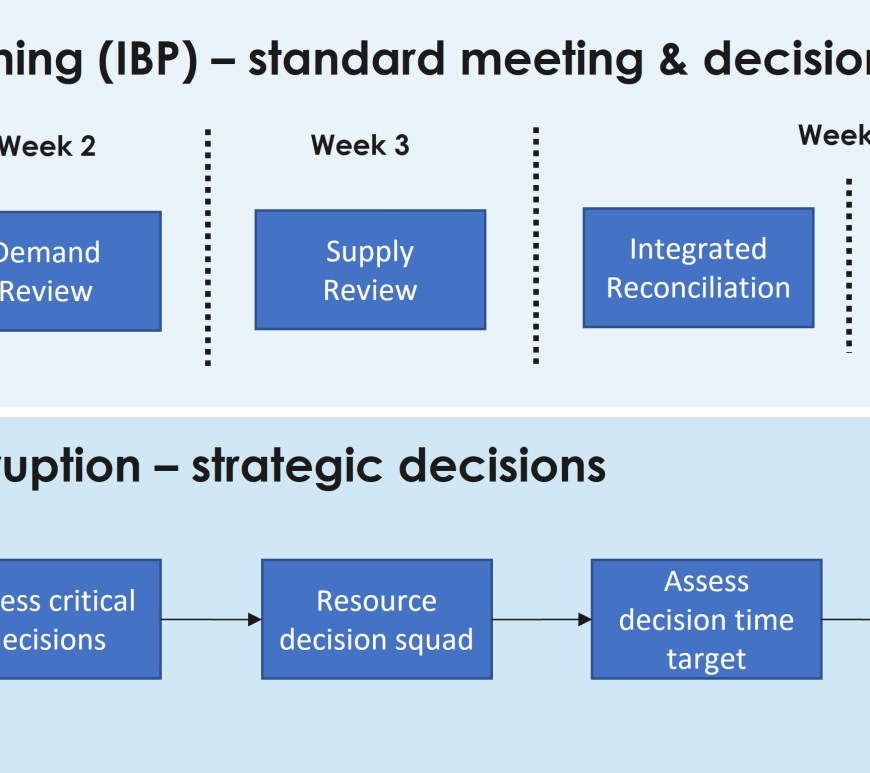
PREVIEW Niels van Hove writes that the limitations of the traditional Integrated Business Planning process are severely magnified during periods of significant disruption, which to many of us seems like the new normal. He argues that the standard meeting-and-decision schedule cannot provide timely strategic responses to disruption, as clearly evidenced by organizational steps during COVID. Instead, Niels offers a new tack centered on an IBP decision … Continue reading A New Approach to IBP Decisions during Crises

Planners Deserve a Better Vision!

We’ve entered an AI era where 76% of work can be augmented or automated. However, only 3% of companies apply automated execution and 7% autonomous end to end planning. 2% of managers apply best practice decision methods. Hardly a recipe for improving planning & decision making. Imagine the opportunity if we closed this massive planning, decision & execution gap with a new planning paradigm. Supported … Continue reading Planners Deserve a Better Vision!

Intelligent IBP – a new role for supply chain planners

Preview – Most IBP cycles around the world are based on a 20-year-old process definition supported by 20-year-old planning concepts. This traditional IBP is not set up for a fast-changing world, where speed of decision making confers a competitive advantage. Intelligent automation will change this. In this series of blogs, I will discuss the transition of traditional IBP towards a more intelligent IBP. Here, you … Continue reading Intelligent IBP – a new role for supply chain planners

Cognitive Automation in Planning & Forecasting

I recently presented at the 41st ISF symposium from the International Institute of Forecasters, where I discussed #cognitiveautomation in planning & forecasting, which is availably in this video (25 min) I cover:– why #artificialntelligence alone is not enough to achieve #intelligentautomation– what’s really required to achieve #autonomousplanning?– boundaries of automation, augmentation & human centricity in decision making– why the human stays central in the #futureofwork Hope you enjoy cheers, Niels Continue reading Cognitive Automation in Planning & Forecasting

Seven reasons why Artificial Intelligence can’t drive business value alone

Artificial intelligence (AI) will be at the center of value creation in the future enterprise. It has the potential to augment and automate both physical labor and the knowledge worker. AI powered cognitive and decision automation has the potential to make ordinary knowledge workers into super humans leading to superior performance, triumphing over human genius and activity alone. However, enterprises should not focus on artificial … Continue reading Seven reasons why Artificial Intelligence can’t drive business value alone

AI Is Here to Automate the Knowledge Worker!

This article is my commentary on an article published in Foresight, written by the authors of the book Humachine: Humankind, Machines, and the Future of Enterprise (Sanders & Wood, 2020). For the original Foresight article and other commentary, you can go here. INTRODUCTION: A NEW ERA The authors of The Humachine make a valid point that enterprises should not focus on artificial intelligence (AI) alone … Continue reading AI Is Here to Automate the Knowledge Worker!

Why Cognitive Automation makes IBP more Agile and more Strategic

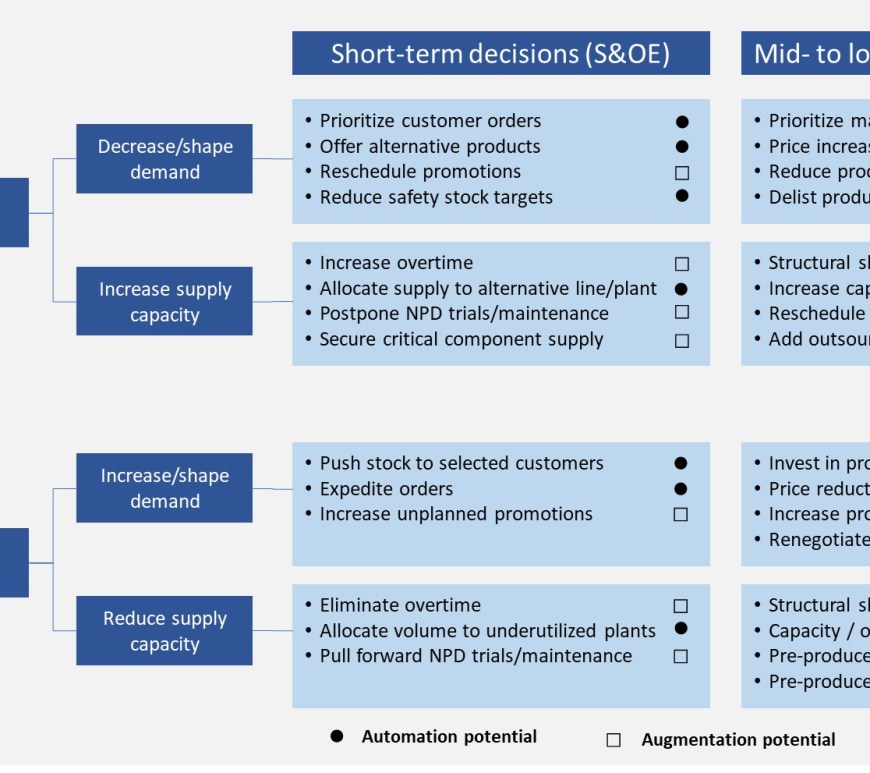
A common IBP cycle has a monthly cadence providing an – up to 24 months – forward view of a business. It is often supported by a weekly control cycle, sometimes called Sales & Operations Execution (S&OE). This cycle plans demand & supply in more detail and over a shorter horizon, often around 12 weeks. IBP is data and resource hungry. Planners spend up to … Continue reading Why Cognitive Automation makes IBP more Agile and more Strategic