

IBP and its predecessor S&OP were developed as executive decision-making forums. In support of effective decision making in the IBP process, we could expect many decision centric capabilities in an organization.
But how decision centric is your S&OP/IBP process, your meetings, your organization? Any idea?
To create some baseline insights, I developed an 11-question checklist to assess IBP decision centricity. Based on this checklist I then conducted an online survey to assess the current state of IBP decision centricity. I got 40 responses and shared some key insights in this blog and the full survey results in this document.
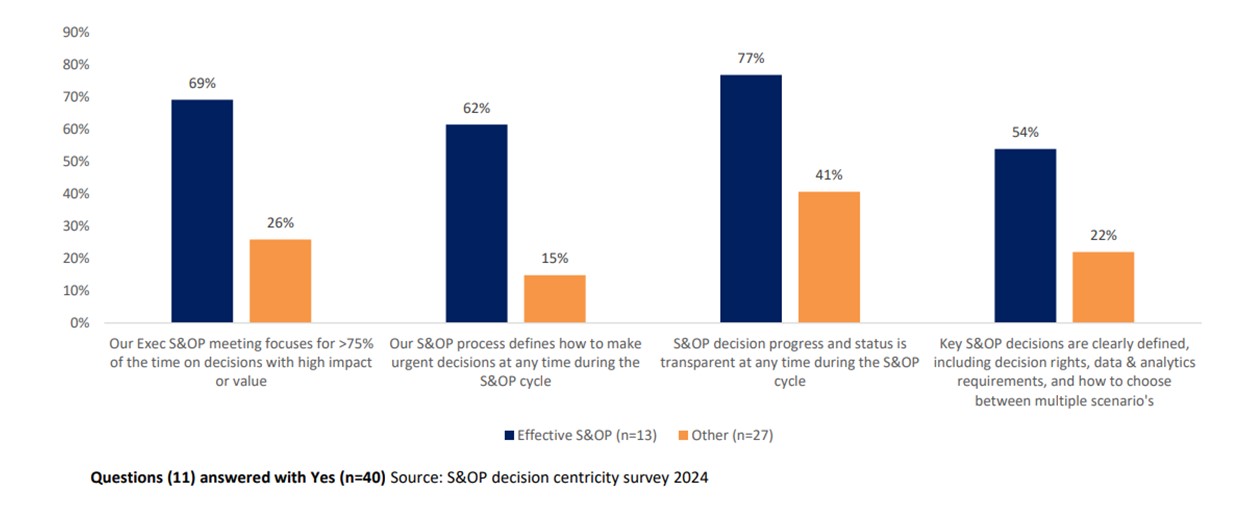
I also asked participants to self judge their S&OP effectiveness and will share the key differences between Decision Centricity in self proclaimed effective and ineffective S&OP processes. As you can see in the graph below, the four key differences are; Decision Focus, Urgency, Transparency & Clarity.
Organisations with effective S&OP processes focus on Decision Making
69 percent of survey participants with self proclaimed effective S&OP processes answered yes to the question ‘Our Exec S&OP meeting focuses for >75% of the time on decisions with high impact or value’. Versus 26 percent for ineffective S&OP (a 43 percent delta). This indicates that organisations with effective S&OP processes focus more of their time on decisions making, whilst ineffective S&OP processes waist time in their meetings doing other things.
Organisations with effective S&OP processes are capable to make Urgent Decisions
62 percent of survey participants with self proclaimed effective S&OP processes answered yes to the question ‘Our S&OP process defines how to make urgent decisions at any time during the S&OP cycle’. Versus 15 percent for ineffective S&OP (a 48 percent delta). Ineffective S&OP processes lack the ability to react faster than a monthly cycle to disruptions or market changes. This seems inadequate in our turbulent times. Business planning during crisis I addressed in this Foresight article.
Organisations with effective S&OP processes have Decision Transparency
77 percent of survey participants with self proclaimed effective S&OP processes answered yes to the question ‘S&OP decision progress and status is transparent at any time during the S&OP cycle’. Versus 41 percent for ineffective S&OP (a 36 percent delta). Transparency can lead to more engagement with the decision making process and is the basis to measure progress and hold people to account.
Organisations with effective S&OP processes have Decision Clarity
54 percent of survey participants with self proclaimed effective S&OP processes answered yes to the question; ‘Key S&OP decisions are clearly defined, including decision rights, data & analytics requirements, and how to choose between multiple scenarios’. Versus 22 percent for ineffective S&OP (a 32 percent delta). Addressing this element is one of the starting points of making consistent & higher quality decisions. S&OP stakeholders can all have opinions and contribute to insights and discussions, but not necessarily have a final decision right. Clarifying upfront how to choose between scenarios, what would be the default choice, and what could change your mind, speeds up decisions making and guides the planner in spending time on the right scenarios.
Conclusion
Decision Centricity is a must in a modern S&OP cycle and in the enterprise as a whole. I identified differences in decision focus between self-proclaimed effective and non-effective S&OP processes. Without making any investment, besides a little bit of discipline, S&OP processes can start becoming more decision centric by addressing some of the 11 decision centric elements highlighted in my survey. Maybe the no-brainer place to start is simply spending 75% of your time making decisions in the next exec S&OP meeting.
 Supply Chain Trend