The Intelligent IBP Manifesto – 50 principles for a new planning paradigm

The IBP paradigm has hardly changed for 30 years, the decision needle has not moved enough. We’ve entered an AI era where 74% of work can be augmented or automated and 26% eliminated. Planning will not be excluded from this evolution. However, only 3% of companies apply automated execution and 7% autonomous end to end planning. 2% of managers apply best practice decision methods. Hardly … Continue reading The Intelligent IBP Manifesto – 50 principles for a new planning paradigm


Reimagining IBP in the Age of AI

What would a Martian expert in supply chain planning and technology think when looking back at earth? With all technology available on earth would it continue with a 30+ year old, sequential, cascading, rather sluggish, manual planning process with a lack of focus on decision digitisation, decision quality and decision learning? Or would it start with a blank sheet and reimagine IBP? Closing the planning … Continue reading Reimagining IBP in the Age of AI

Intelligent IBP: A Need for Decision Centricity

At the core, the IBP process must facilitate executive decision making.

However, it lacks focus on using best practice decisions models to facilitate #decisionquality and #decisionlearning.

We can solve these traditional IBP decision gaps, enable a reduction in decision time and analytics waste, whilst increasing employee engagement with the decision process.

#Decisionintelligence technology can digitize decisions and decision context, create a system of records for decisions and develop a decision memory that helps continuously improve #decisionquality.

This is the fifth in a series of blogs, where I describe how #intelligentautomation and #decisionintelligence can help create a more #intelligentIBP and change the future of work. Continue reading Intelligent IBP: A Need for Decision Centricity

The Limitations of Forecasts and Plans on Decision Making

Forecasters and planners are involved in decision making, but make limited decisions with direct business impact themselves. A forecast is an insight or a foresight, a plan is an intent. A decision is only made when resources are irrevocably allocated to the execution of the decision. Without this, multiple forecast and planning options – as advanced as they may be – remain calculations, maybe insights … Continue reading The Limitations of Forecasts and Plans on Decision Making

A New Approach to IBP Decisions during Crises

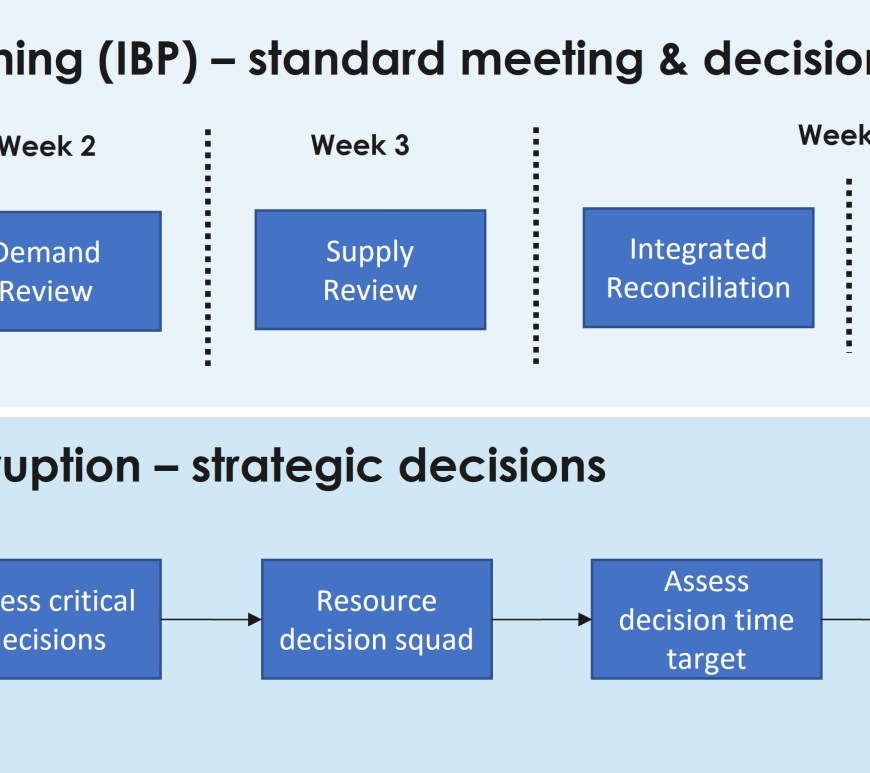
PREVIEW Niels van Hove writes that the limitations of the traditional Integrated Business Planning process are severely magnified during periods of significant disruption, which to many of us seems like the new normal. He argues that the standard meeting-and-decision schedule cannot provide timely strategic responses to disruption, as clearly evidenced by organizational steps during COVID. Instead, Niels offers a new tack centered on an IBP decision … Continue reading A New Approach to IBP Decisions during Crises

Planners Deserve a Better Vision!

We’ve entered an AI era where 76% of work can be augmented or automated. However, only 3% of companies apply automated execution and 7% autonomous end to end planning. 2% of managers apply best practice decision methods. Hardly a recipe for improving planning & decision making. Imagine the opportunity if we closed this massive planning, decision & execution gap with a new planning paradigm. Supported … Continue reading Planners Deserve a Better Vision!

A Better Plan is not Necessarily a Better Decision

Some new language has been creeping in the planning vocabulary in the last year or two: planning & decision making. What used to be planning, or a planning system, is now sometimes referred to as planning & decision making. This is most likely influenced by the acknowledgement of a new category decision intelligence by Gartner, for which they provided a definition since 2022. I now … Continue reading A Better Plan is not Necessarily a Better Decision

How to Close the Planning & Execution Automation Gap

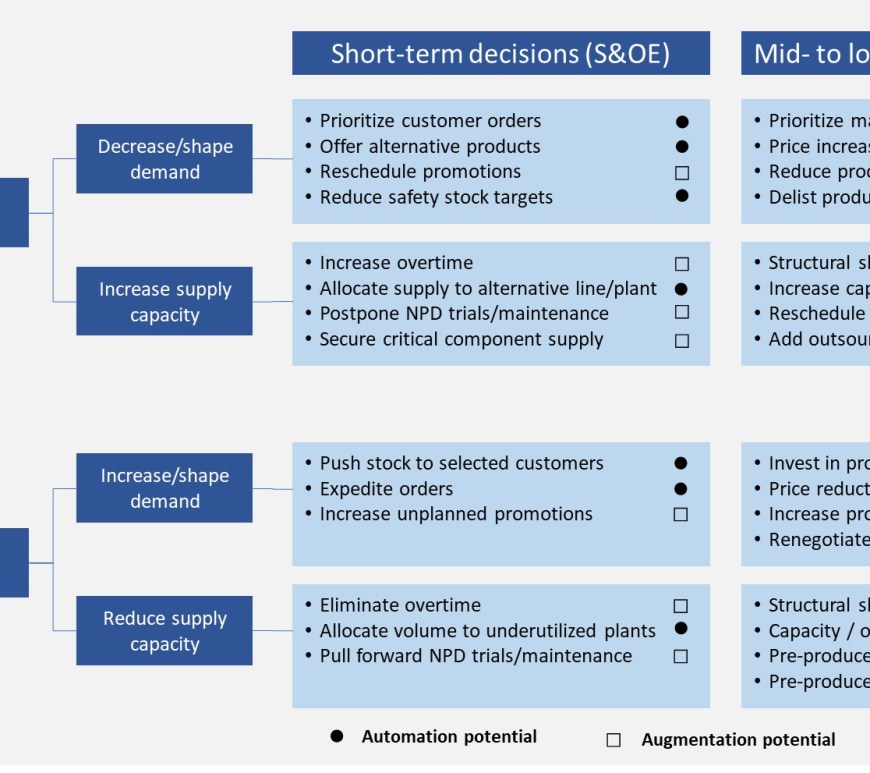
There was a lot of interest and commentary on my last post on the Automating of Routine Collaborative Decisions in S&OE. So much that I decided to do a webinar with my colleguae Ruan Van Vuuren. Especially the below schematic got a lot of reactions. It shows for a large global beverage business, what decisions could be automated in the S&OE horizon. Although for every … Continue reading How to Close the Planning & Execution Automation Gap

The Automation of Routine Collaborative Decisions in S&OE

The Sales & Operations Execution (S&OE) cycle is a much-needed addition to your S&OP/IBP process. I used to implement it as ‘The Control Cycle’. Gartner came up with S&OE and Oliver Wight now calls it ITP (Integrated Tactical Planning). Whatever you call it, you better have it as a business if you want to react to short term disruptions Where your IBP process focuses on … Continue reading The Automation of Routine Collaborative Decisions in S&OE

Intelligent IBP – a new role for supply chain planners

Preview – Most IBP cycles around the world are based on a 20-year-old process definition supported by 20-year-old planning concepts. This traditional IBP is not set up for a fast-changing world, where speed of decision making confers a competitive advantage. Intelligent automation will change this. In this series of blogs, I will discuss the transition of traditional IBP towards a more intelligent IBP. Here, you … Continue reading Intelligent IBP – a new role for supply chain planners