

IBP and its predecessor S&OP were developed as executive decision-making forums. In support of effective decision making in the IBP process, we could expect many decision centric capabilities in an organization.
Improving IBP decision centricity results in improvements like:
👉 Increased decision speed
👉 Improved decision quality
👉 Reduced decision bias
👉 Less analytics waste
👉 Effective decision learning
👉 Improved engagement with decision process
But how decision centric is your IBP process, your IBP meetings, your organization? I created an 11-question checklist to assess IBP decision centricity. Based on this checklist I then conducted an online survey to assess the current state of IBP decision centricity. I got 40 responses and share some key insights.
IBP decision centricity insights
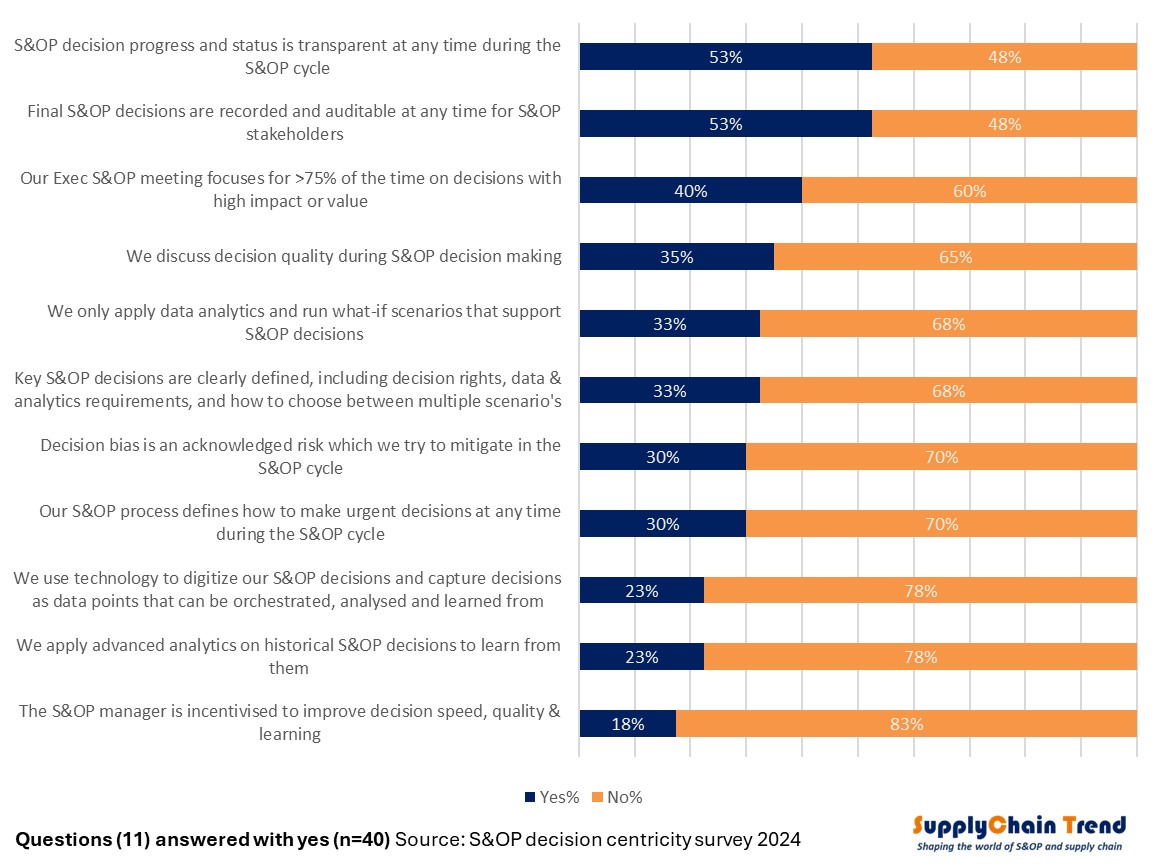
18% of survey participants answered yes to the question “The S&OP manager is incentivized to improve decision speed, quality & learning.” This indicates that S&OP managers are not sufficiently rewarded to improve decisions. The S&OP incentive package remains likely focused on planning outcomes, rather than including decision improvements.
23% of survey participants answered yes to the question “We use technology to digitize our S&OP decisions and capture decisions as data points that can be orchestrated, analyzed and learned from.” This indicates a lack of digitization of decisions and potentially using decision intelligence platforms to do so. Only digitization of decisions and its context can provide efficient auditability, transparency, decision analytics & learning from decisions.
23% of survey participants answered yes to the question “We apply advanced analytics on historical S&OP decisions to learn from them.” This indicates a lack of learning from decisions. Although some learning is possible without decision analytics, when we digitize our decisions, we can use more advanced techniques like machine learning to classify inputs, decision and decision context and outputs, and learn from them.
30% of survey participants answered yes to the question “S&OP process defines how to make urgent decisions at any time during the S&OP cycle.” This indicates a lack of decision agility in the S&OP process. Disruption often requires organizations to make decisions with a faster clock speed than the S&OP cycle. Something for which I provided a solution in this paper.
30% of survey participants answered yes to the question “Decision bias is an acknowledged risk which we try to mitigate in the S&OP cycle.” This indicates a lack of awareness and focus on preventing human bias in S&OP decision making. Gartner observed that 65% of organizations admit to using data and analytics primarily to validate pre-made decisions, hence admitting being bias and low decision quality.
On a somewhat positive note, 53% of survey participants answered yes to the question “S&OP decision progress and status is transparent at any time during the S&OP cycle.’ And 53% of survey participants answered yes to the question “Final S&OP decisions are recorded and auditable at any time for S&OP stakeholders.’ This indicates well recorded, stored and accessible S&OP decisions progress during the S&OP cycle and after S&OP decisions have been made. Both are essential to facilitate decision learning.
Find below a graphical representation for all the 11 questions, for which I have called out the bottom five and the top two. How decision centric is your S&OP/IBP process?
You can view the full decision centric IBP survey report here.
To assess your IBP decision centricity and compare with my study, download the checklist here.
 Supply Chain Trend
One thought on “IBP decision centricity study: a lack of managing bias, speed, digitization, incentives & learning”