
Planners make plans…
With their plans they facilitate decision making in the S&OP process, rather than making decisions with a direct business impact themselves.
Planning systems create plans…or schedules…
The outcomes of advanced planning systems (APS), as advanced as they may be, are plans, schedules, analytics, insights, alerts, scenario’s, at best recommendations…not S&OP decisions!
An APS system can be considered a system of record for schedules, plans, probabilities, planning assumptions, maybe planning knowledge. It is not a system of records for decisions!
A better plan, doesn’t necessarily mean a better decision! It requires a whole lot of decision intelligence beyond planning to make timely, unbiased, consistently high quality decisions, capture them and learn from them.
A digital transformation doesn’t make you decision centric. Neither does a good planning process or system. In fact, in my recent survey on S&OP decision centricity, 53% of participants indicated their S&OP process shows low levels of decision centric characteristics. Only 5% showed high levels of decision centricity. Many participants would have gone through a digital transformation or work with APS systems.
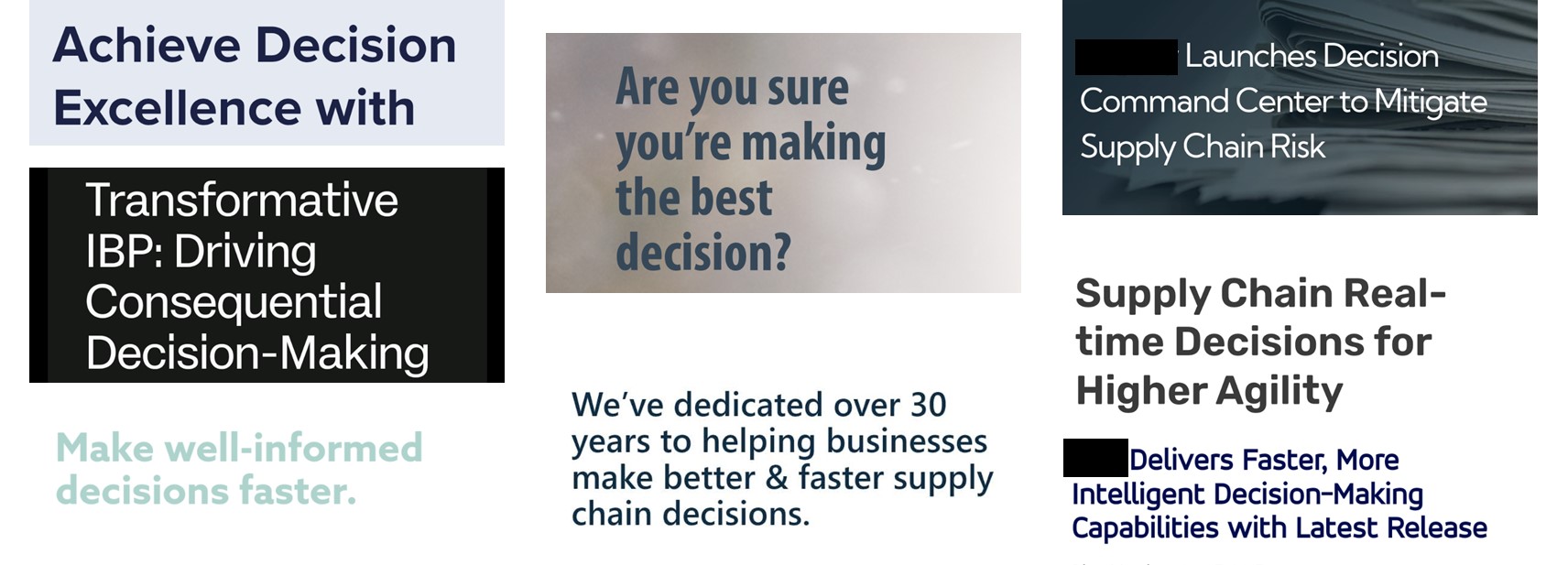
The rise of decision intelligence and the growing need for decision centricity has resulted in the ‘decision washing’ of advanced planning systems. Below picture shows the ‘decision washing’ website communication from a selection of APS vendors from Gartner’s magical quadrant for S&OP and supply chain planning.

They confuse plans and planning technology, with decision making and decision intelligence technology. It has to be said, an authentic minority remains focused on communicating about improving planning processes, the real capability of an APS. Sure, APS systems support planners to facilitate decisions, they are needed and they are useful. But they do not define decision centricity and are not decision intelligence platforms.
Decision intelligence technology is focused on the decision. It can orchestrate decision making as a measurable data-to-action business process. S&OP decisions supported by decision intelligence technology are digitized and the decision context is captured. This creates a system of record for decisions, where the decision itself, the steps, decision maker, the value, the impact, are all data points that can be analyzed, monitored, and learned from.
If you are confused and not sure, use this simple rule of thumb: Is the key data element in the software a transaction (ERP), a plan (APS) or a decision and its context (Decision Intelligence platform).
Becoming decision centric requires a rethink of our vision, planning operating models, roles & responsibilities, our mindset & behaviours and incentives, just to name a few. I’ve previously highlighted some decision centric capabilities which can certainly be further extended.
Don’t be ‘decision washed’ and believe that becoming decision centric is solved by improved planning!
Acknowledgement: the term ‘decision washing’ I saw first used by Erik Larson
 Supply Chain Trend